Calculating your hourly rate as a tradesperson: how to price without made-up figures
· By Kyle Nelson
Your hourly rate is your yearly business costs plus the pay you need, divided by the hours you can actually bill, plus a mark-up for risk and result. Billable hours are fewer than the hours you are on the clock, so divide by the billable ones. On the quote, show the work as a line with quantity, unit and price.
What does an hourly rate have to cover?
The hourly rate is not only the pay for the hours on site. It also has to carry what the business spends before and after the work itself.
Start from your own records. Documented costs, realistic working time, and prices you can explain later on the quote.
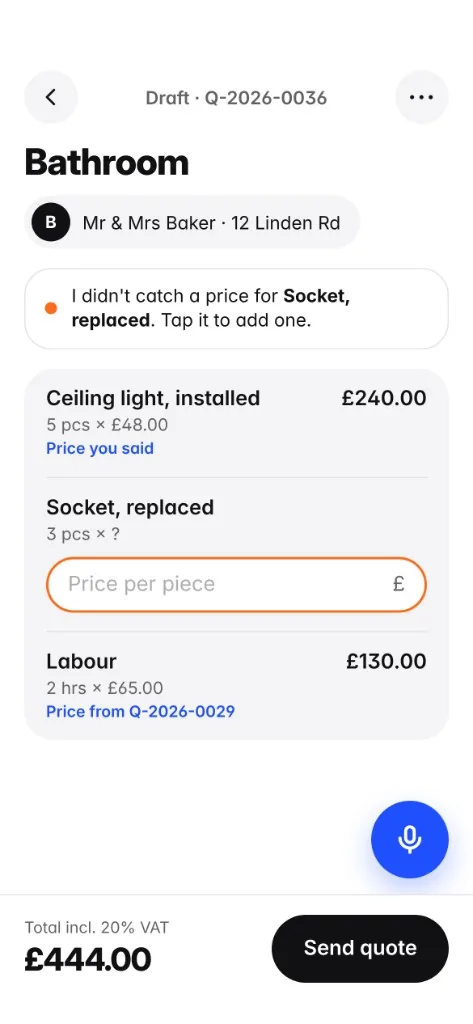
Do not invent a line to finish faster. If a price is missing, mark it and settle it before the quote goes to the customer. Quotebefore tells you before export if the price is missing.
The calculation scheme
Split the sum into fixed blocks. Then decide how the work should appear on the quote.
| Block | What you record | What it gives you |
|---|---|---|
| Business costs | Running costs the jobs have to cover | A cost share per hour |
| Working time | Time you can bill, and time you cannot bill directly | The basis for the internal hourly rate |
| Pay | Your own time, or an employee's time | A pay cost per hour |
| Mark-up | Risk, work done up front, and the result you need | An uplift on the cost rate |
| Quote line | Quantity, unit and price for the work | A price on the quote you can trace |
The internal hourly rate is a working figure. On the quote it can be an hourly line, a fixed price, or another unit, depending on how you describe the work.
How do you show the hourly rate on a quote?
If you quote by the hour, write the line so the customer can see which work that hour covers. Quantity, unit and price belong on the line.
What must appear on a quote depends on your country and business type. Use our free UK quote template or US contractor estimate template; both list the details with official sources.
What are the typical hourly rate mistakes?
A rate based on gut feeling. Individual jobs can look fine while the business costs are not covered.
Mixing up the hourly pay and the selling price. Pay is one part. The quoted price also has to cover organising and finishing the job.
Old prices used without a look. If you reuse an earlier quote, check that the work still matches.
Checklist
- Are the running costs written down?
- Is it clear which time you can actually bill?
- Is pay looked at separately from the selling price?
- Are materials and subcontracted work checked on their own?
- Is the mark-up for risk set on purpose?
- Can you trace the prices you reused?
- Are open prices settled before you send?
- Does each line show quantity, unit and price?
Checking the quote
The calculation is finished only when the quote can be checked. For each line, ask three questions: is the work described clearly, is the unit right, and can you back up the price? If one answer is no, do not send yet.
For work you do often, your own earlier quotes are a base. They do not replace a look at this job. If you use an app to capture the lines, the criteria in The best quoting app for tradespeople in 2026 are the ones to apply.
Faster with Quotebefore
On the iPhone, describe the job on site. Speech recognition and extraction turn it into line items with quantities and units. Prices come from your own earlier quotes. If the job, the quantities or the price are missing, Quotebefore tells you before export. The app reminds you on working days 3, 7 and 12 after the quote is sent, then stops. No account.
Sources
- Quotebefore on the UK App Store, first 3 quotes free and follow-up reminders: https://apps.apple.com/gb/app/quotebefore-job-quote-maker/id6801658124
- Quotebefore on the US App Store, first 3 estimates free: https://apps.apple.com/us/app/quotebefore-estimate-maker/id6801658124
- Apple Support, Cancel a subscription from Apple: https://support.apple.com/en-us/118428